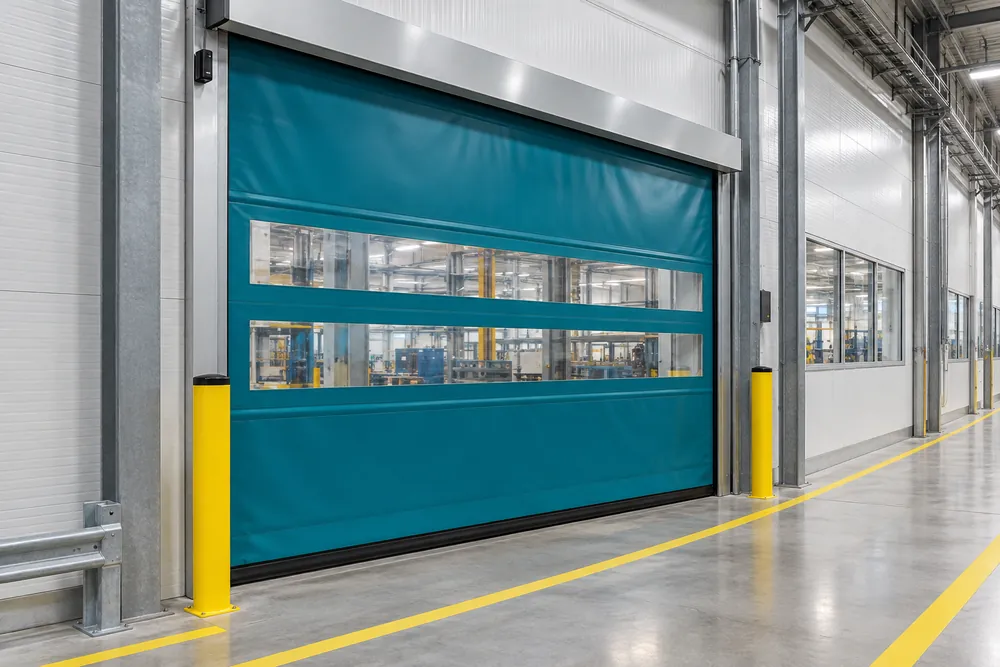
When Faster Operation Helps
A conventional shutter may be a poor match for an opening that cycles repeatedly during production. A high-speed door can reduce the time the opening remains exposed between movements. The useful benefit depends on how the route is used rather than a headline opening speed.
These doors can separate warehouse zones, help control draughts and support a defined movement route. Temperature-sensitive spaces need a specification suited to the conditions. Do not assume that a general fabric door is suitable for every chilled or controlled environment.
Start by recording what passes through the opening and how often it happens. Forklifts, pallet trucks and pedestrians create different detection and segregation requirements. The door specification should follow those movements rather than encourage vehicles to travel faster.
Select The Door Construction
Flexible curtains, insulated constructions and rigid high-speed designs serve different applications. The decision depends on exposure, temperature difference, expected impacts and security needs. An internal fabric partition may need a separate external security closure outside operating hours.
Vision panels can improve awareness across a route, but they do not replace traffic controls. The width and height must provide clearance for the loads and equipment using the opening. Record overhanging loads and turning movements rather than measuring the forklift alone.
Where impacts are a recurring issue, discuss the intended recovery method and the limitations of any re-entry system. A curtain that can be reset after a minor displacement still needs inspection after damage. No construction should be presented as immune to vehicle impact.
Activation And Protective Functions
Radar, loops, pull cords and access-control signals can be considered according to the application. Detection zones need careful positioning so unrelated movement does not continually open the door. Adjacent equipment and cross traffic can affect what the sensor sees.
Automatic closing requires suitable protection for the risks at the opening. The assessment considers trapping, contact with the moving curtain and foreseeable misuse. A light curtain or safety edge must be selected and installed as part of the complete control system.
Agree how the door behaves during a fault and how authorised staff can make the area safe. Avoid workarounds that bypass a protective device to keep traffic moving. A recurring nuisance stop needs diagnosis because it may indicate a detection, alignment or control problem.
Survey Through To Use
The survey records structure, clear dimensions, power provision and adjacent equipment. It should also consider air movement and pressure differences between the spaces. These conditions can affect the choice of curtain and how the door behaves during operation.
The installation sequence needs an exclusion area and a plan for alternative movements while work is underway. Check the interface with any existing shutter so one system cannot create a hazard for the other. Agree responsibility for wiring, sensors and external control signals before installation.
Commissioning should test the agreed activation and protective functions in the installed setting. Authorised users need instructions on normal use, fault reporting and the permitted recovery procedure. Keep settings and product information accessible to the maintenance team.
Standards, Servicing And Cost
BS EN 12453 addresses safety in use of powered doors, with BS EN 13241 relevant to the product specification. The installation needs its own risk assessment and suitable documentation. A faster operating cycle does not change the duty to protect people around the moving door.
Servicing needs to reflect repeated operation and the manufacturer’s requirements. Curtain wear, guide condition, sensors and controls all deserve attention. Note changes in cycle behaviour promptly rather than waiting until the door becomes unusable.
Cost depends on opening size, curtain or panel type, activation method, environmental requirements and the available installation space. Integrating signals from conveyors or other equipment can add work beyond the door itself. A useful quotation identifies those interfaces and the testing required before normal operation.
When enquiring, describe the route, typical loads, indoor or outdoor position and any need for temperature separation. If the main requirement is overnight security rather than frequent movement, compare our commercial roller shutters instead. This keeps the choice tied to the business problem the opening must solve.
Further Guidance: HSE: powered-door safety · BSI: BS EN 12453
High-Speed Doors FAQs
Is A High-Speed Door A Security Shutter?
A high-speed door is not automatically a security shutter. Flexible internal doors are commonly selected for traffic and environmental separation, while security requirements may need a separate closure or a different construction. Explain any insurer or landlord requirement before choosing a product so the complete opening can be specified appropriately.
Can High-Speed Doors Work With Forklift Traffic?
High-speed doors can serve forklift routes when the opening, activation and protective functions are suitable for the traffic. The assessment needs vehicle and load dimensions, approach direction and pedestrian movements. Detection settings should support a safe route. Door speed must never be used as a reason to increase vehicle speed.